
DDoS (Distributed Denial of Service) attacks are one of the most prevalent disruptions that cost businesses millions of dollars each year. These attacks can take your websites or services completely offline, impacting your customers, and ultimately harming your business.
The good news? In this article, we’ll explore the best DDoS protection services you can use to keep your business safe online.
Here is our list of the seven best DDoS protection tools and services:
- ManageEngine NetFlow Analyzer EDITOR’S CHOICE A full traffic and bandwidth monitoring platform. It delivers multi-vendor flow-based monitoring and anomaly detection. Start a 30-day free trial.
- ManageEngine Log360 (FREE TRIAL) A comprehensive security platform that helps detect DDoS attacks, so you can take preventive action. It helps with remediation and incident response as well. Start a 30-day free trial.
- Indusface AppTrana This is a cloud platform that can serve up to 700,000 connection requests per second and absorb DDoS floods while passing genuine traffic on to your server.
- AWS Shield DDoS protection for applications and services hosted in the AWS cloud.
- SolarWinds Security Event Manager Combines ease of use with flexible protection while still maintaining control of your DDoS traffic settings.
- Link11 German-based DDoS protection service that uses AI to identify threats.
- Project Shield Splintered off of Google, Project Shield offers free protection to news agencies and nonprofits.
- Neustar Can use BGP or DNS routing to mitigate attack traffic.
The Best DDoS Protection Services
1. ManageEngine NetFlow Analyzer (FREE TRIAL)
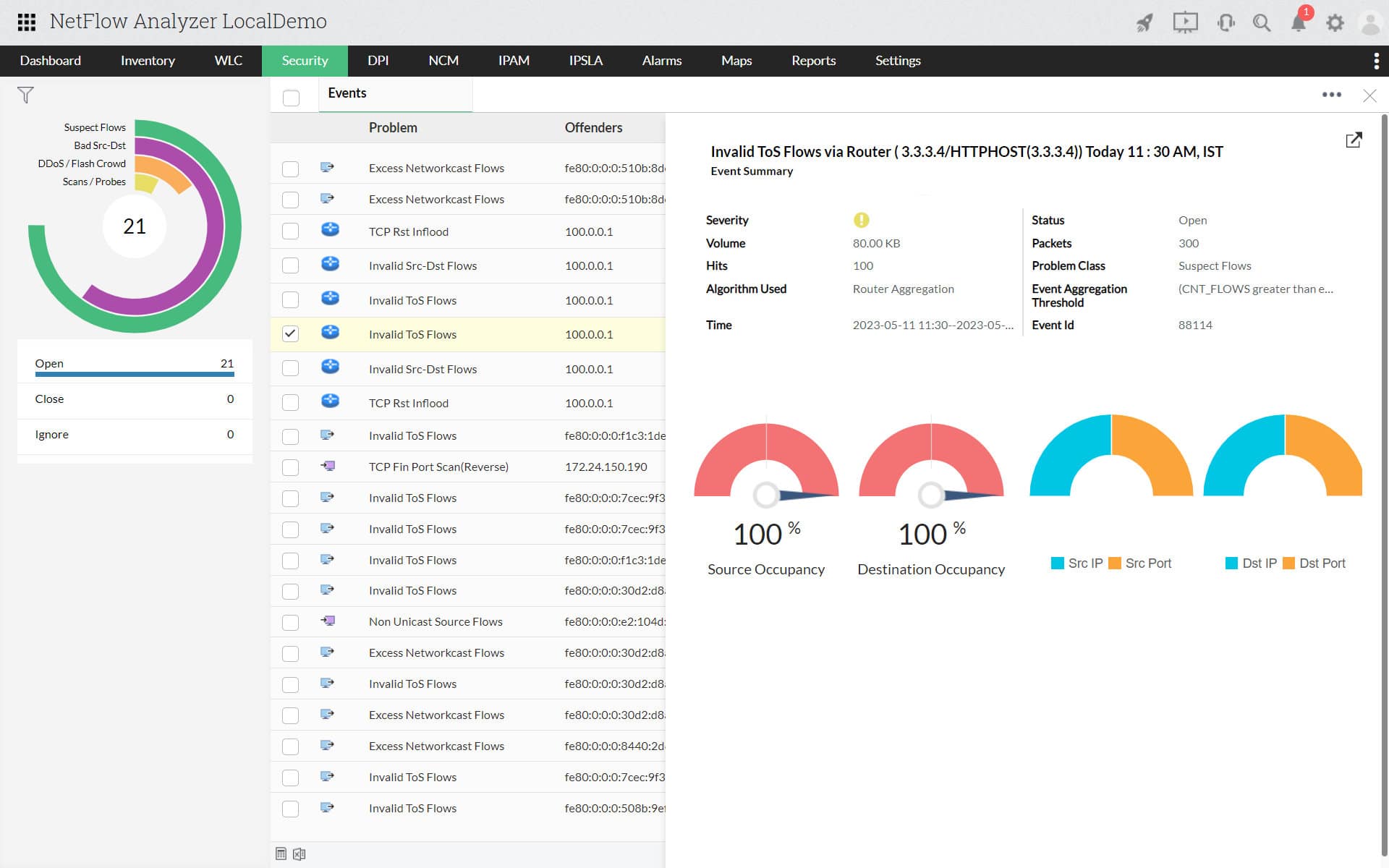
ManageEngine NetFlow Analyzer is a flow-based traffic analysis and bandwidth monitoring platform. It gives you end-to-end visibility into how your network is being used. It supports NetFlow, sFlow, IPFIX, J-Flow, and more. With such protocol support, it can help administrators understand traffic patterns and mitigate threats.
One of the standouts is that the platform continuously monitors interfaces and applications across the network. With this monitoring, it can highlight bandwidth hogs, suspicious spikes, and DDoS-style anomalies. Additionally, its security module combines deep packet inspection with anomaly baselining to detect advanced threats. These early alerts add an extra line of defense, which is especially good for enterprises under constant pressure from floods or slow-drip attacks.
Deployment is available via Standard, Professional, and Enterprise editions. You can scale from a single-site business to large distributed networks. The built-in features like NBAR integration for Layer 7 visibility and IP SLA monitoring for VoIP and video make it adaptable to different environments. But its value doesnt end there. Its integration with other ManageEngine ITOM tools and third-party SIEMs extends the value. The tool also comes with live dashboards and historical reports. These features help administrators drill down and review top talkers or check forensic details after an incident.
ManageEngine Netflow Analyzer also uses AI/ML to power forecasts. This is perfect for supporting capacity planning and helping justify bandwidth investments to stakeholders. Although some users note that upgrades and add-on licensing can be complex, the breadth of functionality makes it a strong competitor to tools like SolarWinds and Cisco.
Pricing depends on edition and deployment size, but ManageEngine offers a 30-day free trial to evaluate the product before diving into commitments.
EDITOR'S CHOICE
ManageEngine NetFlow Analyzer is our top pick for DDoS protection in network monitoring. The solution offers a rare combination of real-time traffic visibility, anomaly detection, and deep forensics. Plus, its Security Module (ASAM) can rapidly identify and alert on suspicious spikes and lateral threat movement. With this functionality, you can have a strong frontline defense against DDoS and insider threats. Unlike traditional tools that focus only on traffic volume, NetFlow Analyzer uses machine learning to baseline normal behavior and flag outliers. This feature gives your IT team the ability to act before an attack escalates. The solution also provides scalability. For enterprises managing complex networks, it provides centralized visibility across vendors and environments.
Download: Get a 30-day FREE trial
Official Site: https://www.manageengine.com/products/netflow/
OS: Windows, Linux
2. ManageEngine Log360 (FREE TRIAL)
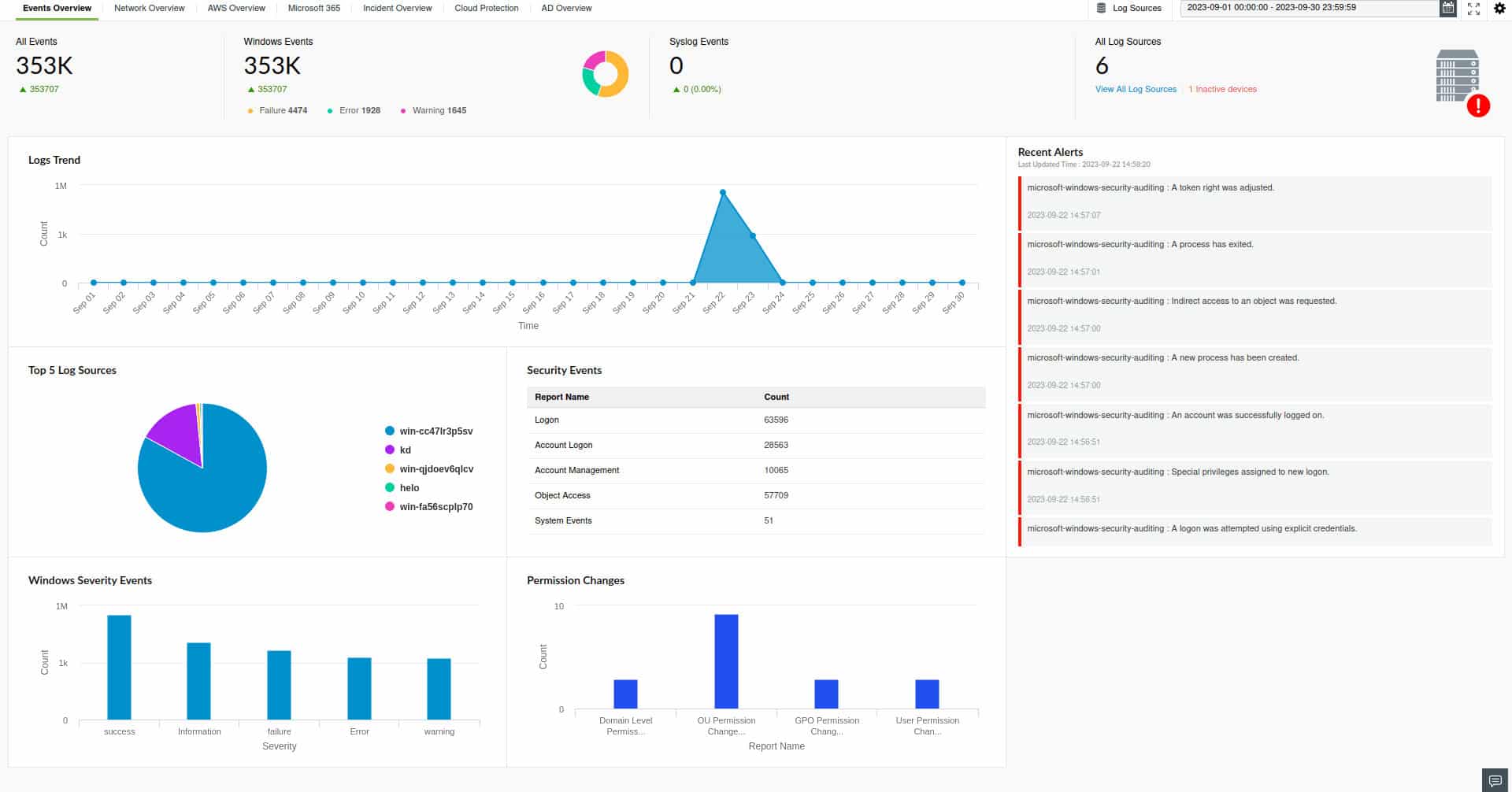
ManageEngine Log360 is a comprehensive log analysis tool that helps identify security events like DoS and DDoS attacks, so you can take measures to prevent them from creating a wide impact. This tool gathers data from different sources and analyzes them to identify signs of potential attacks. Specifically, it brings together log data from firewalls, IDS/IPS web servers, and network devices to identify early traffic spikes that could indicate a DDoS attack.
Additionally, it also gathers threat intelligence feeds from global databases and MITRE ATT&CK to correlate inbound traffic, so you can identify suspicious IP addresses that have been blocklisted globally. Traffic from such sites is another indicator of a potential attack. Similarly, it takes data from DNS query logs to identify protocol abuse and malformed packet structures, which are other indicators of DDoS attacks. Such a comprehensive analysis greatly reduces the impact of these attacks.
The results of this analysis are displayed on real-time dashboards, which help to understand the root cause of the problem, so you can fix it. The reports help with auditing and compliance, and support stakeholder communication.
With such features, Log360 is highly effective in preventing DDoS attacks. Download a 30-day free trial.
3. Indusface AppTrana

Indusface AppTrana is a cloud-based proxy service that provides a Web application firewall with a bot manager and DDoS protection. This tool is good for protecting websites and APIs. AppTrana is hosted on the AWS platform and it provides processing power of 2.3 Tbps and can serve 700.000 connection requests per seeking.
The bot manager in AppTrana recognizes that some bots are good. The tool has access to a blacklist of source IP addresses that include the known exit points of the Tor network and data centers that are known for generating a lot spam and malicious transmissions.
DDoS attacks are produced by botnets that are made up by large numbers of privately-owned but infected computers or devices. The owners of these devices are not to blame for the attacks but the traffic from them needs to be dealt with – some traffic from each of those IP addresses might be genuine.
AppTrana hosts your SSL certificate and forms a server for HTTPS encryption. This means that it is able to remove all encryption and scan the contents of packets, enabling it to identify malware and hacker activity. The system can also block application-level DDoS attacks.
The base DDoS blocking system in AppTranas operates at Layers 3 and 4 of the OSI model. It will block ICMP Ping floods and TCP SYN floods It can also absorb reflection attacks and slow/low attacks.
It takes just two or three minutes to set up AppTrana when you subscribe. The service is offered as a WAF package, called the Advanced Edition. You can get the system as a managed service, which is called the Premium Edition. Indusface offers a free trial of the Advanced Edition.
4. AWS Shield
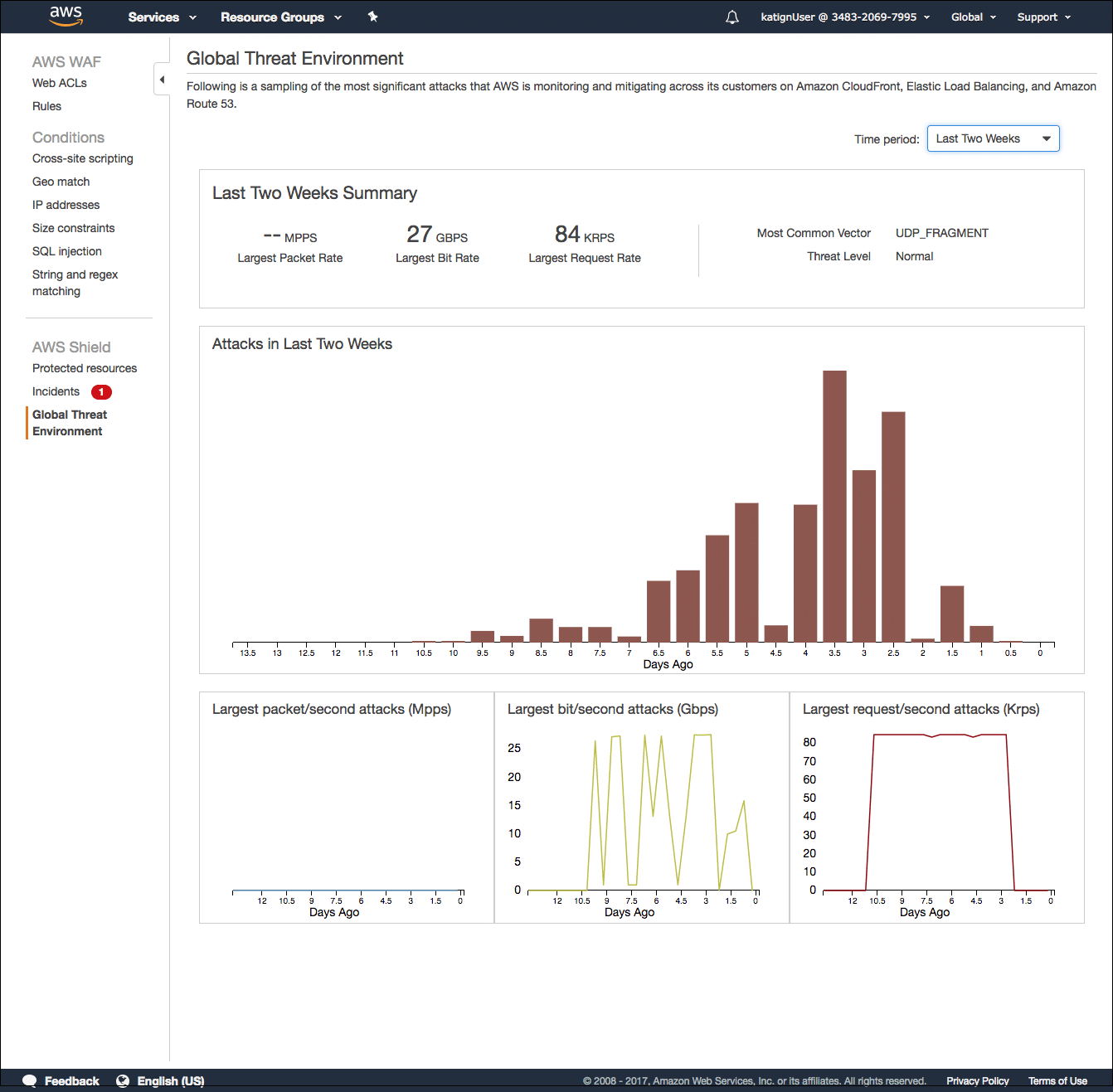
AWS Shield is hosted by Amazon Web Services and provides DDoS protection as a managed service. If you already have an application or service hosted by AWS, its DDoS protection is automatically available.
DDoS attacks can be mitigated on multiple different levels with AWS Shield. Active traffic monitoring constantly monitors all traffic to your services and can check for both network flow and application traffic monitoring.
Common attacks like SYN floods, UPD floods, ACK floods, and reflection attacks can all easily be stopped before they cause an outage. You can choose to set a threshold condition, where if reached will drop all traffic from a hostname or IP address. AWS Shield uses a flexible rules engine that makes it easier to configure your protection settings when compared to more traditional DDoS mitigation services.
All of your security settings can be reviewed through a built-in best practices and architecture review that ensures there are no glaring holes in your DDoS protection settings.
For AWS Shield Standard this comes in the form of a self-assessment, but for those who opt to use Shield Advanced these settings are reviewed by an AWS security expert. If you’re already using AWS WAF (Web Application Firewall) you can take advantage of additional security benefits such as instant rule updates and self-service Layer 7 mitigations.
AWS Shield comes in two versions, Standard and Advanced. AWS Shield Standard provides adequate protection for smaller businesses and stops basic DDoS attacks. AWS Shield Advanced includes advanced traffic mitigation with Elastic Load Balancing and gives you access to additionally attack layer visibility and reporting.
Pricing for AWS Shield Advanced starts at $3000 per month. Additional services like Elastic Load Balancing and AWS Global Accelerator will be billed separately depending on traffic usage. You can learn more about AWS Shield on the AWS homepage.
5. SolarWinds Security Event Manager
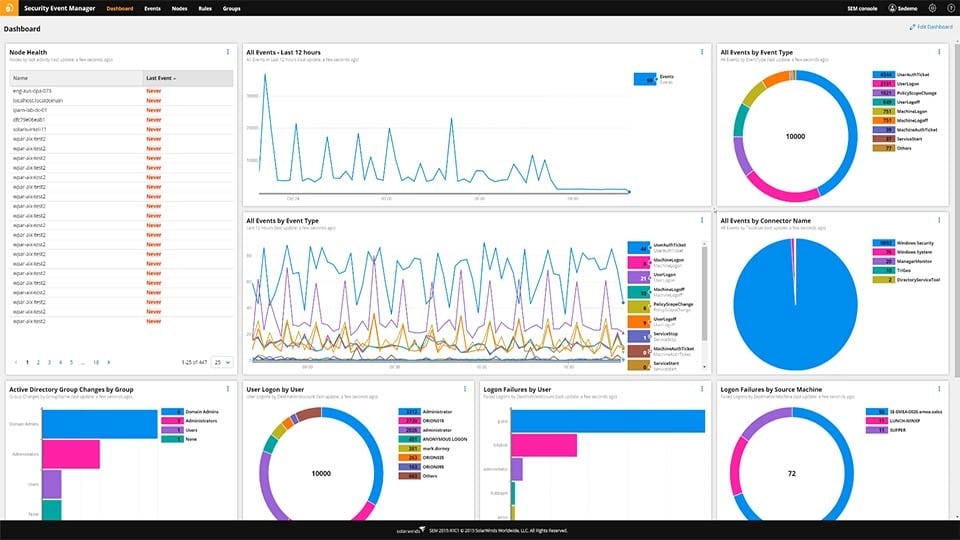
SolarWinds Security Event Manager (SEM) is an intuitive yet effective DDoS protection tool that allows organizations to manage their own security. SolarWinds SEM comes preconfigured with best practices in place that give you a firm foundation to work from.
SEM manages a comprehensive list of known bad actors and IP addresses and automatically prevents them from passing through to your site. This list is populated both by the SolarWinds security team and submissions from its users.
Automated responses ranging from custom alerts to blocking an IP, to terminating an account can be configured through a simple interface. SolarWinds SEM can also analyze data and alert you if there are any suspicious events that are deviating from the normally expected baseline of traffic. This helps raise the alarm and detect acts like malicious probing before the business is impacted.
SolarWinds event logging is extensive and comes with built-in forensic tools that give you the power to review how a DDoS was carried out. This not only helps you build a legal case against the attackers but allows your security team to identify holes in your defenses and patch them. Events can be sorted in a number of ways to identify IP addresses, user accounts, targeted services, and attack methods.
SolarWinds SEM starts at $4,655 (£3,819). You can try SolarWinds Security Event Manager completely free through a 30-day trial.
6. Link11

Link11 is a German cybersecurity company that offers a multitude of protection services including defense against DDoS attacks.
The Link11 platform utilizes advanced AI to identify DDoS attacks and stop them in their tracks. They boast a quick detection time and claim to be able to stop known attacks instantly, and new attacks in under 10 seconds.
This cloud-based protection detects attacks through Layers 3-7 in real-time by using a combination of signature and pattern recognition and is simple to set up. Traffic to your application or service is routed through Link11 first to filter and protect against attacks.
As the AI system protects more applications, it learns over time. Every time an attack is thwarted, the details of that attack are stored in a database. If a similar set of events happens again, the system can identify and predict how the attack will progress. This method essentially stops attacks before they even have the chance to gain moments. Currently, Link11 has stopped over 200,000 attacks to date.
Link11 displays your analytics through a simple yet informative dashboard and gives you both real-time and historical insights on attacks against your network. Metrics like the number of threats stopped and bandwidth saved put your ROI in a direct perspective while using the platform.
There are a number of preconfigured reports that you can generate for your records, or share with stakeholders. Dashboards insights can be shared and reports can be generated either manually or sent at regular intervals.
Pricing for Link11 is not publicly available; you can however contact Link11 support for a trial version.
7. Project Shield
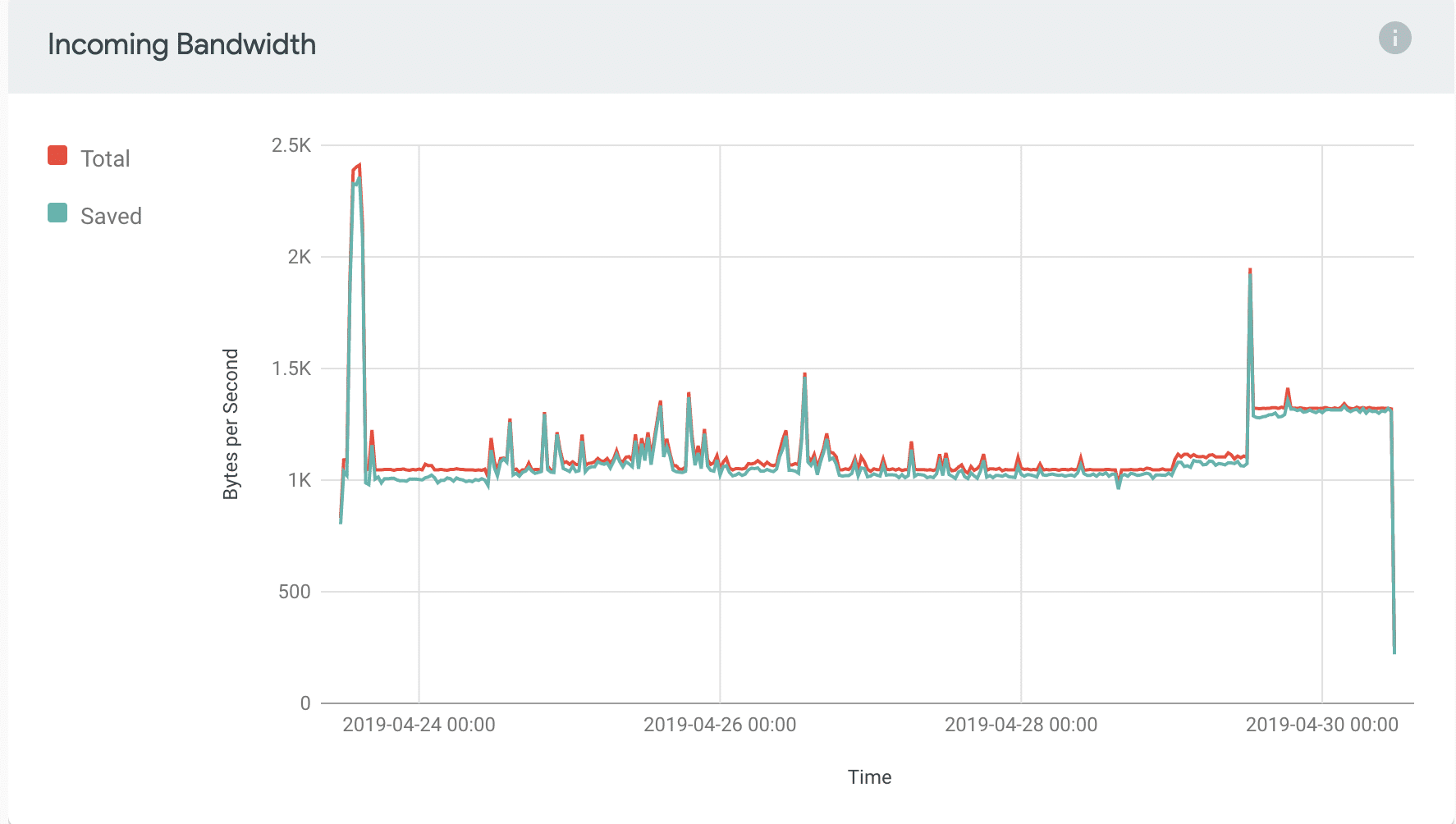
Project Shield is operated by Jigsaw, a branch of the Alphabet company that aims to make DDoS protection accessible to the masses. Project Shield initially was started to protect small businesses, journalists, and activists from mass scale DDoS attacks.
Project Shield has been slowly expanding its services and is proving to be a worthy DDoS protection service. In 2016 Project Shield offered its reverse proxy protection to news organizations completely for free. By using machine learning AI, Project Shield is configured to be a ‘set it and forget it’ anti-DDoS tool.
While Project Shield is still in its early stages, the platform is quickly becoming known as a service that fights to protect businesses who otherwise couldn’t protect themselves. At this time Project Shield is available to a select group of companies including nonprofit organizations, news organizations, and political parties.
You can apply for Project Shield on their application page.
8. Neustar

Nuestar offers many different forms of DDoS protection through a combination of cloud-based, on-premises, and hybrid setup DDoS protection services. The company currently provides DDoS protection services across the world by routing traffic to 14 data scrubbing centers around the globe.
For on-premises solutions, Neustar uses the Pravvail Protections Availability System designed by Arbor networks. This appliance sits between your firewall and ISP and can sort traffic ranging anywhere from 500 Mbs to 10 Gbps. This physical appliance can stop attacks operating on Layers 4 through 7, and can even act as a cloud failover.
If your current system is approaching the traffic mitigation threshold, you can opt to have this traffic directed to Neustar’s UltraDDoS Protect cloud. This failover utilizes BGP routing or DNS direction to shift your DDoS prevention from onsite to cloud-based during severe attacks.
There are multiple ways you can configure failover, but one of the most effective is through automated routing. This works by giving you the ability to set thresholds and configure rulesets that trigger automated actions. These actions can range from redirecting traffic to other WANs, initiating a cloud-based failover, or dropping specific packets altogether.
All of these settings as well as real-time data of your network traffic status can be viewed via the web console. If a DDoS attack does occur, a post-attack report is generated by Neustar that breaks down how the attack unfolded, and what measures were done to mitigate and stop traffic.
Pricing for Nuestar is not publicly available, and there is no free trial available at this time. You can reach out to the Nuestar sales team for more information.
Choosing a DDoS Protection Service
In this article we’ve narrowed down the best DDoS protection services to just seven products, but which one is right for you?
For most medium to large-sized MSPs and IT departments, ManageEngine NetFlow Analyzer will give you the best balance of protection and control over your security and traffic.
SolarWinds SEM comes out of the box with best practices in place while still giving you granular control over exactly how that traffic is handled.
If you run a non-profit, news agency, or are involved with a political party, Project Shield is a great free DDoS protection service specifically designed for those industries.
Have you ever been on the receiving end of a DDoS attack? How did you handle it? Let us know in the comments below.


